Vegas Unfiltered: Chasing the City’s Iconic Skyline One Landmark at a Time
Las Vegas isn’t just a destination—it’s a visual explosion. From the moment you spot its skyline, you know you’re somewhere unlike any other. I went not for the tables, but for the architecture—the bold, the bizarre, the breathtaking. What I found were landmarks that don’t just tower above the desert, but define the spirit of reinvention. This is a city that builds dreams in steel and light, then dares you to look away. Every structure tells a story of ambition, imagination, and the relentless pursuit of wonder. For travelers seeking more than chance, the true magic lies in the skyline itself.
The First Glimpse: Arrival on the Strip
Approaching Las Vegas from the south along Interstate 15, the first sign of civilization isn’t a building or a billboard—it’s a glow on the horizon. The Mojave Desert stretches endlessly, a sea of beige and sagebrush under an open sky, when suddenly, the earth seems to ignite. That glow resolves into a forest of light, rising defiantly from the sand: the Las Vegas Strip. The skyline emerges not gradually, but with dramatic insistence, as if the city refuses to be ignored. This is where the journey truly begins—not with a step onto pavement, but with a moment of awe.
The visual impact of the Strip at night is unmatched in the modern world. Over 4,000 illuminated signs and structures stretch across four miles, creating a continuous display of color, motion, and scale. The tallest buildings pierce the sky like lighthouses for dreamers, their spires wrapped in neon, LED ribbons, and kinetic displays. What makes this skyline so unforgettable is not just its brightness, but its contrast. The desert offers silence and stillness; Las Vegas answers with rhythm and spectacle. It’s a place where nature recedes, and human imagination takes center stage.
Architecturally, the Strip is a timeline of American pop culture. Each era has left its mark—from the mid-century kitsch of the 1950s to the opulent excess of the 1990s and the sleek futurism of the 2020s. Resorts are designed to be seen from afar, their facades engineered for maximum visibility. The Luxor’s black glass pyramid, the Stratosphere Tower’s needle-like spire, the replica Eiffel Tower at Paris Las Vegas—each is a landmark in its own right, contributing to a skyline that is instantly recognizable, even to those who’ve never visited. This deliberate grandeur ensures that the first glimpse of Las Vegas is never forgotten.
For many visitors, especially women between 30 and 55 who travel for relaxation, inspiration, and shared experiences, this first view sets the tone. It’s not about gambling or nightlife—it’s about being transported. The city’s scale and energy awaken a sense of possibility. You don’t just arrive in Las Vegas; you enter a different reality, one where the rules of ordinary life don’t apply. The skyline isn’t just a collection of buildings—it’s an invitation to wonder, to explore, and to rediscover the joy of being amazed.
The Bellagio: Where Elegance Meets Spectacle
Among the many icons of the Strip, the Bellagio stands apart—not for being the tallest or the loudest, but for its mastery of balance. It is a resort where luxury and performance coexist in perfect harmony. From the moment you approach, the building’s classical façade, inspired by the Italian village of Lake Como, offers a sense of refinement often missing in a city known for excess. The white columns, arched windows, and symmetrical design speak of tradition and grace, a deliberate contrast to the chaos of light and sound just steps away.
But it is the lake in front of the resort that steals the show. The Bellagio Fountains are more than a water display—they are a choreographed symphony of movement and music. Over 1,200 jets shoot water as high as 460 feet into the air, dancing in time to a curated playlist that ranges from classical arias to modern pop. The show runs every 30 minutes in the evening, drawing crowds who gather on the sidewalk, phones in hand, faces lifted in delight. What makes this experience so powerful is its emotional resonance. Water, a symbol of life and renewal, is especially meaningful in the desert. To see it leaping, swirling, and sparkling under the Nevada sky is to witness a small miracle of engineering and artistry.
Equally captivating is the Bellagio Conservatory & Botanical Garden, located just inside the main entrance. This ever-changing exhibition features thousands of live flowers, intricate sculptures, and seasonal themes—from spring blossoms to winter holidays. The attention to detail is extraordinary: handcrafted figurines, flowing streams, and ambient lighting create a world that feels both magical and serene. For many visitors, especially those seeking beauty and tranquility, this indoor garden is a sanctuary. It offers a quiet counterpoint to the city’s relentless energy, a place to pause, breathe, and reflect.
The Bellagio’s enduring appeal lies in its ability to offer multiple layers of experience. It is not just a hotel or a casino—it is a destination for the senses. The fountains provide drama, the conservatory offers peace, and the fine dining, shopping, and art installations (including the famous “Fiori di Como” glass ceiling by Dale Chihuly) add depth. In a city that often celebrates the new and the flashy, the Bellagio reminds us that elegance never goes out of style. It proves that spectacle and sophistication can coexist, and that beauty, when thoughtfully crafted, can become timeless.
The High Roller: A New Perspective from 550 Feet
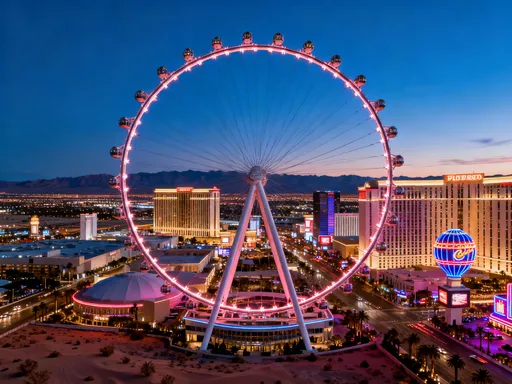
Rising 550 feet above the Strip, the High Roller at The LINQ Promenade is more than an observation wheel—it is a reimagining of how we experience Las Vegas. Unlike the traditional focus on ground-level attractions, this modern landmark invites visitors to rise above the noise and see the city from a new vantage point. Each of its 28 climate-controlled cabins holds up to 40 people, offering a 30-minute journey that combines panoramic views with a sense of calm. As the wheel turns slowly, the Strip unfolds below like a living map of light and motion.
The experience begins before you even board. The LINQ Promenade, a pedestrian-friendly stretch of shops, restaurants, and entertainment, has been transformed into a vibrant social hub. Street performers, music, and open-air dining create a lively atmosphere that appeals to families and groups of friends. The High Roller, positioned at the center of this space, acts as both a landmark and a connector. It draws people in, not just for the ride, but for the sense of occasion it creates. For many women traveling with friends or daughters, the ascent becomes a shared moment—a toast with champagne in a glass-bottom cabin, a photo against the setting sun, a quiet conversation above the crowd.
From the top, the view is nothing short of breathtaking. To the south, the “Welcome to Fabulous Las Vegas” sign glows against the desert. To the north, the skyline stretches toward downtown, with the Stratosphere Tower and the new Resorts World complex marking the horizon. The contrast between the city’s glittering core and the surrounding emptiness is stark and beautiful. You can see how the Strip is both a world unto itself and a fragile oasis in the vastness of the Mojave. This perspective shifts the way you understand Las Vegas—it is no longer just a collection of resorts, but a human-made phenomenon, bold and temporary, built on dreams.
The High Roller also symbolizes a broader shift in Las Vegas tourism. Once defined by casinos and late-night shows, the city now embraces experiences that are inclusive, scenic, and memorable for all ages. Observation wheels, rooftop bars, and open-air attractions are redefining what it means to “do” Vegas. The High Roller is not about gambling or risk—it’s about elevation, literally and metaphorically. It offers a moment of reflection, a chance to step back and appreciate the scale of what has been built. In a city that never stops moving, it provides a rare gift: stillness with a view.
The Sphere: Vegas’ Boldest Statement in Light and Sound
At the northern end of the Strip, a new icon has emerged—one that redefines the very idea of architecture. The MSG Sphere is not just a building; it is a technological masterpiece, a 366-foot-tall sphere wrapped in the world’s largest and highest-resolution LED screen. When lit, its surface becomes a canvas for dynamic visuals—rippling oceans, starfields, abstract patterns—that can be seen for miles. At night, it pulses like a living planet, a beacon of innovation in a city always chasing the next big thing.
Inside, the experience is equally revolutionary. The Sphere seats up to 18,600 guests in a perfectly hemispherical auditorium, where every seat has an unobstructed view of the 16K resolution screen that curves overhead and around the audience. But it’s not just the visuals that impress—it’s the sound. The venue features the first-ever 3D audio system at this scale, using thousands of speakers to create an immersive environment where music, dialogue, and effects seem to move through space. When artists like U2 perform here, the result is not a concert but a sensory journey—one that blurs the line between live performance and virtual reality.
The Sphere represents a new chapter in Las Vegas entertainment. Unlike traditional arenas or theaters, it is designed to be a destination in itself. The exterior screen broadcasts live events, art installations, and community messages, turning the building into a public storyteller. During major holidays or global events, it becomes a shared screen for the city, uniting visitors and locals in collective wonder. For travelers seeking the cutting edge, the Sphere offers a glimpse of the future—where architecture, technology, and art converge to create experiences that are both personal and universal.
Its construction was not without challenges. The project required groundbreaking engineering, including a custom steel exoskeleton and advanced cooling systems to manage the desert heat. Yet its impact goes beyond engineering—it’s cultural. The Sphere has become a symbol of Las Vegas’ willingness to take risks, to build not just for today, but for tomorrow. It appeals to those who value innovation and artistry, who come not just to be entertained, but to be amazed. In a city full of landmarks, the Sphere stands out as a monument to what is possible when creativity meets ambition.
The Welcome to Fabulous Las Vegas Sign: Simplicity That Endures
At the southern end of the Strip, just off Las Vegas Boulevard, stands a landmark that needs no introduction. The “Welcome to Fabulous Las Vegas” sign, erected in 1959, is a masterpiece of mid-century modern design. Standing 25 feet tall, it features a slender metal frame adorned with red, yellow, and white neon tubing, spelling out its iconic message in a clean, elegant script. At night, it glows like a vintage postcard, a beacon of arrival for millions of visitors.
What makes this sign so powerful is its simplicity. Unlike the towering resorts or high-tech attractions, it offers no bells and whistles—just a warm, timeless greeting. Yet it has become one of the most photographed landmarks in the United States. Couples pose in front of it, families take group shots, and solo travelers capture a moment of arrival. For many, it marks the beginning of a journey, a rite of passage into the world of Las Vegas. The sign doesn’t sell luxury or excitement—it offers recognition, a sense that you’ve reached a place that matters.
The sign’s survival is a testament to its cultural value. Though it once faced demolition in the 1990s, public outcry led to its preservation and eventual relocation to a safer, more visible location. Today, it is protected as a historic landmark and maintained by the Nevada Department of Transportation. Its design, created by Betty Willis, remains unchanged—a rare example of original roadside architecture that has not been commercialized or altered. In a city that constantly reinvents itself, the sign is a reminder of where it all began: as a destination for dreamers, adventurers, and anyone seeking a little sparkle in their lives.
For women traveling for self-discovery, celebration, or connection, the sign holds special meaning. It represents a threshold—not just to a city, but to a version of themselves they want to embrace. Standing in front of it, smiling under its glow, they are not just tourists—they are participants in a shared story. The sign doesn’t judge or impress; it welcomes. And in that simple act of welcome, it becomes something more than metal and light. It becomes a symbol of possibility, a promise that whatever you’re seeking, you might just find it here.
The Cosmopolitan and Aria: Modern Minimalism on the Rise
As the Strip has evolved, so too has its architecture. Rising from the central corridor of the CityCenter complex, the Cosmopolitan and Aria represent a shift toward modern minimalism and urban sophistication. Gone are the themed facades of pyramids, castles, and volcanoes. Instead, these towers feature sleek glass exteriors, clean lines, and a focus on verticality. The Cosmopolitan’s black glass façade shimmers like a polished stone, while Aria’s crystalline design reflects the sky, changing color with the light of day.
This modern aesthetic is not just about looks—it’s about experience. The interiors are designed to feel like cosmopolitan cities within a city. Open atriums, natural materials, and curated art installations create a sense of calm and refinement. The Cosmopolitan’s Chandelier bar, suspended in a three-story glass orb filled with 2 million crystals, is a work of art in itself. Aria’s sky bridges connect towers at high altitudes, offering views and a sense of connection between spaces. These resorts cater to travelers who value design, comfort, and a more intimate atmosphere.
Public spaces are equally important. The Park, a green oasis between the two resorts, features fountains, trees, and open lawns—rare elements in a city dominated by concrete and neon. It hosts outdoor concerts, yoga sessions, and seasonal events, making it a gathering place for both visitors and locals. The emphasis on walkability, art, and sustainability reflects a new vision for Las Vegas—one that balances entertainment with well-being, spectacle with serenity.
For women who appreciate style, culture, and meaningful experiences, the Cosmopolitan and Aria offer a different kind of luxury. It’s not about excess, but about intention. The lighting is subtle, the music curated, the service attentive without being intrusive. These resorts prove that Las Vegas can be both glamorous and grounded, exciting and peaceful. They represent a maturation of the city’s identity—one that welcomes those who come not to lose themselves, but to find something new.
Final Thoughts: Why Landmarks Define the Vegas Experience
Las Vegas is often misunderstood. Many see it as a city of chance, of excess, of fleeting moments. But to walk its Strip is to encounter something deeper—a celebration of human creativity, resilience, and imagination. Each landmark, from the historic neon sign to the futuristic Sphere, tells a story of ambition. They are not just buildings or attractions; they are declarations of what we can build when we dare to dream.
The city’s architectural diversity is its greatest strength. It offers something for every kind of traveler—the romantic, the adventurer, the artist, the seeker. You can stand beneath the Bellagio fountains and feel awe, rise in the High Roller and gain perspective, or stand before the vintage sign and feel welcomed. These moments are not incidental—they are the heart of the experience.
For women who travel to recharge, reconnect, or rediscover joy, Las Vegas offers more than entertainment. It offers inspiration. In a world that often feels uncertain, the city stands as a testament to possibility. It reminds us that beauty can rise from the desert, that light can emerge from darkness, and that even the most impossible ideas can become real.
So come not just to play, but to witness. Come to see what happens when a city decides to build not just for profit, but for wonder. Walk the Strip, look up, and let the skyline speak to you. Because in Las Vegas, the buildings don’t just reach for the sky—they invite you to rise with them.