Walking Through Time: The Living Architecture of Teotihuacan
Standing before the Pyramid of the Sun at dawn, I felt the weight of centuries beneath my feet. Teotihuacan isn’t just ruins—it’s a city that still breathes through its stones. Its architectural genius reveals a civilization obsessed with harmony, alignment, and grandeur. Every step along the Avenue of the Dead tells a story written in symmetry, slope, and sacred design. This is not just sightseeing—it’s immersion in a lost world’s living blueprint. The morning light climbs the pyramid’s tiers like a slow revelation, illuminating surfaces worn smooth by wind and time. As the shadows recede, the city awakens—not with sound, but with presence. Here, architecture is memory made visible, and walking its paths is akin to reading a manuscript carved in earth and stone.
First Light on the Avenue of the Dead
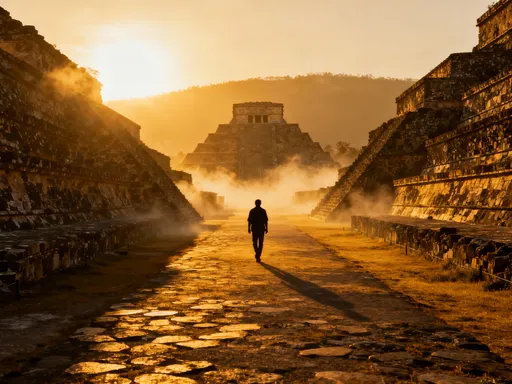
As the first rays of sun stretch across the Valley of Mexico, the Avenue of the Dead emerges from the mist like a path drawn by gods. This central spine of Teotihuacan runs nearly three miles from south to north, flanked by pyramids, platforms, and the remnants of once-thriving compounds. The name, given by the later Aztecs who revered the site as a place of ancestors, evokes mystery—but the avenue was never a cemetery. Instead, it served as the ceremonial and urban core of one of the largest cities in the pre-Columbian Americas, home to as many as 125,000 people at its peak around 450 CE.
The alignment of the avenue is not arbitrary. It is oriented slightly east of true north, believed to correspond with the setting of the Pleiades, a star cluster of profound significance in Mesoamerican cosmology. This celestial precision underscores the city’s role as a mirror of the cosmos. As visitors walk its length today, they follow the same axis that priests and pilgrims once traversed during sacred processions. The scale is staggering: the avenue is up to 130 feet wide in places, paved with compacted stone and lime, and elevated above the surrounding terrain, reinforcing its symbolic separation from the mundane world.
What strikes the modern walker most is the silence. Despite the proximity to Mexico City, just 30 miles away, the site feels removed in time as much as space. The stillness amplifies the visual rhythm of the architecture—pyramids rising at measured intervals, platforms standing like sentinels, and the horizon dominated by the twin peaks of the Pyramid of the Sun and the Pyramid of the Moon. This deliberate pacing of structures along the avenue was not merely aesthetic; it structured ritual movement, guiding participants through a sequence of spiritual revelations. Each turn, each ascent, was a step closer to the divine.
For families and solo travelers alike, the early morning offers the most profound experience. Crowds are thinner, temperatures are mild, and the soft light enhances the textures of weathered stone. It is in these quiet hours that the city feels most alive—not with people, but with presence. The Avenue of the Dead does not lead to burial chambers, but to understanding: a journey through space that becomes a journey through time, belief, and human aspiration.
The Pyramid of the Sun: Power in Proportion
Dominating the eastern side of the Avenue of the Dead, the Pyramid of the Sun is the largest structure in Teotihuacan and one of the most massive in the ancient Americas. Rising 216 feet with a base measuring 730 by 760 feet, it covers an area larger than the Great Pyramid of Giza. Built around 100 CE, it predates the city’s peak but remained central to its identity. Its sheer volume—estimated at over one million cubic meters of material—speaks to an extraordinary mobilization of labor and vision. Yet no written records survive to tell us who commissioned it or what rituals unfolded at its summit.
What we do know comes from archaeology and astronomical observation. The pyramid is aligned with remarkable precision to the sunset on certain dates tied to the solar calendar, particularly the days when the sun stands directly overhead in this region—an event that occurs twice a year. This alignment suggests the pyramid functioned not only as a temple but as a giant calendrical instrument, marking time and seasons for agricultural and ceremonial purposes. Its four stepped levels, originally faced with stucco and possibly painted, rise in a series of diminishing tiers, creating a geometric ascent that draws the eye—and the spirit—skyward.
The construction methods remain a subject of awe. Without the use of the wheel, draft animals, or metal tools, the builders quarried and transported massive amounts of volcanic rock, adobe bricks, and rubble from nearby hills. Evidence suggests they used wooden rollers, ropes, and human labor in coordinated teams, likely organized by neighborhood or craft guilds. Ramps of earth and stone may have spiraled around the growing structure, allowing workers to haul materials upward. Once complete, the ramps were dismantled, leaving no trace but the finished monument.
At the pyramid’s core lies a natural cave, discovered in the 1970s, which may have been the original reason for its location. In Mesoamerican belief, caves were seen as portals to the underworld, the source of life and fertility. By building the pyramid over this cave, the Teotihuacanos may have been symbolically uniting the earthly realm with the sacred depths below and the celestial realms above. Today, visitors can climb the reconstructed staircase to the first terrace, where panoramic views of the entire city unfold. While climbing higher is restricted for preservation, even this partial ascent offers a visceral sense of scale and reverence. The Pyramid of the Sun does not merely impress—it humbles.
The Temple of the Feathered Serpent: Myth Carved in Stone
In stark contrast to the massiveness of the Pyramid of the Sun, the Temple of the Feathered Serpent offers an intricate dialogue between art and power. Located at the southern end of the Avenue of the Dead, this six-tiered pyramid is renowned for its elaborate façade, where alternating heads of the feathered serpent Quetzalcoatl and a related aquatic deity emerge from under stylized feathered headdresses. Over 200 stone carvings adorn the temple’s front, each meticulously sculpted with serpentine jaws, fangs, and plumed crests. These are not mere decorations; they are theological statements in stone.
The feathered serpent deity, known later to the Aztecs as Quetzalcoatl, represented the union of earth and sky—the serpent as a creature of the ground, the feathers as symbols of the heavens. This duality reflects the Teotihuacan worldview, where opposites were not in conflict but in balance. The temple’s construction, dated to around 200–250 CE, coincides with a period of significant political and religious development in the city. Archaeologists have uncovered evidence of elite burials beneath the pyramid, some accompanied by sacrificial victims, suggesting it was both a religious center and a monument to ruling authority.
The architectural style of the temple exemplifies the talud-tablero form—a defining feature of Teotihuacan design. Each level consists of a sloping panel (talud) surmounted by a vertical rectangle (tablero), creating a rhythmic, almost wave-like progression up the pyramid. This design was not only visually striking but ideologically potent. It spread throughout Mesoamerica, appearing in sites as far away as Tikal in Guatemala and Copán in Honduras, indicating Teotihuacan’s cultural influence extended far beyond its borders.
The temple also reveals a sophisticated understanding of urban aesthetics. It stands within the Ciudadela, a vast enclosed complex that could have housed administrative functions or elite residences. The surrounding platforms may have hosted public gatherings, where the imagery of the feathered serpent reinforced state ideology. Unlike later Mesoamerican temples adorned with human skulls or explicit war imagery, the Temple of the Feathered Serpent emphasizes creation, renewal, and cosmic order. Its artistry reminds us that power in Teotihuacan was not only demonstrated through size but through symbolism, precision, and spiritual narrative.
Urban Design Beyond Monuments: Living Spaces and Symmetry
While the pyramids command attention, the true marvel of Teotihuacan lies in its city planning. Unlike many ancient capitals centered solely on royal or religious structures, Teotihuacan was a carefully organized metropolis designed for daily life. Scattered across the valley are more than 2,000 residential compounds, each functioning as a self-contained neighborhood. These were not haphazard dwellings but multi-family apartment complexes, built with uniformity, access to water, and communal spaces—evidence of a highly structured society.
The compounds typically surrounded a central courtyard, with rooms opening inward, offering privacy and protection from the elements. Walls were constructed of adobe brick or stone, coated with lime plaster, and many interiors were painted with murals depicting deities, nature scenes, or ritual processions. The uniformity of design suggests a centralized planning authority, possibly a council of leaders or a theocratic government. Archaeologists have found little evidence of a single royal palace, indicating power may have been more distributed than in other ancient civilizations.
Street grids intersect the city at regular intervals, aligned with the Avenue of the Dead and oriented to the cardinal directions. Drainage systems, including stone-lined channels and underground conduits, managed rainwater and wastewater, preventing flooding and maintaining hygiene. Some compounds even had private bathrooms with flush mechanisms—advanced for their time. Markets, craft workshops, and storage facilities were integrated into the urban fabric, allowing residents to live, work, and worship within walking distance.
This balance between public and private life reflects a society that valued order, community, and sustainability. The absence of overt displays of wealth or extreme social stratification in housing suggests a more egalitarian structure, at least among the urban population. For modern visitors, walking through these residential zones offers a rare glimpse into the everyday lives of people who lived 1,500 years ago—not as distant ancestors, but as planners, artists, and neighbors who built a city meant to endure.
Materials and Methods: How the City Rose from Earth
The builders of Teotihuacan worked with what the land provided. The city sits in a valley rich in volcanic basalt, a dense, durable rock formed from ancient lava flows. This material became the backbone of Teotihuacan’s construction—quarried, shaped, and stacked into walls, platforms, and pyramids. Adobe bricks, made from sun-dried clay and straw, were used for upper walls and residential structures, offering insulation and flexibility. Surfaces were often covered with stucco, a lime-based plaster that could be smoothed, painted, or incised with designs.
The logistics of construction were monumental. Transporting thousands of tons of stone required coordinated labor, likely organized through a system of rotating service obligations. Workers may have belonged to calpulli, or neighborhood-based groups, responsible for contributing labor to public projects. There was no currency, so compensation likely came in the form of food, housing, or access to communal resources. This collective effort underscores a society where civic duty and spiritual purpose were intertwined.
Construction techniques reveal ingenuity. Wooden scaffolds and ropes enabled workers to lift heavy stones. Ramps, some temporary and others integrated into the final design, allowed movement of materials to higher levels. Floors were leveled using simple tools like plumb bobs and sighting rods, yet the precision achieved is remarkable—many structures align within a few degrees of true north. Roofs were flat, supported by wooden beams and covered with compacted earth, a design well-suited to the region’s dry climate.
Sustainability was inherent in their methods. By using local materials, the Teotihuacanos minimized environmental strain and transportation costs. Their buildings were designed to last, with thick walls and protective coatings that resisted erosion. Even today, after centuries of exposure, the core structures remain standing, a testament to their craftsmanship. This deep connection to the land—building not upon it, but with it—offers a lesson in harmony that modern urban planners continue to study.
Alignment and Cosmology: Architecture as a Celestial Map
Teotihuacan was not just built on the earth—it was built with the sky in mind. The entire city functions as a three-dimensional model of the cosmos, where architecture encodes astronomical knowledge and spiritual belief. The Avenue of the Dead, though slightly offset from true north, aligns with the setting of the Pleiades, a cluster associated with creation and renewal. The Pyramid of the Sun mirrors the position of the sun at zenith, while the Pyramid of the Moon at the northern end completes the celestial triad, echoing the lunar cycle.
The placement of structures follows a symbolic grid that reflects Mesoamerican cosmology: the world divided into cardinal directions, each associated with a color, deity, and natural force. East, the direction of sunrise, was linked to red and the god of dawn; west, the sunset, to black and the realm of ancestors; north, to white and wisdom; south, to blue-green and fertility. Buildings were often painted in these colors, reinforcing their cosmic associations. Rituals performed at specific times and locations would have synchronized human activity with celestial events, creating a living calendar.
This integration of time, space, and belief was not unique to Teotihuacan, but it was executed here with unparalleled scale and precision. Unlike later cities that adapted to terrain, Teotihuacan reshaped its landscape—flattening hills, redirecting streams, and leveling vast tracts of land to fit its sacred plan. The city was, in essence, a ritual instrument, designed so that every resident, from priest to potter, lived within a framework that connected daily life to the movements of the heavens.
Modern archaeoastronomy has confirmed many of these alignments through surveys and computer modeling. The solstice sun, when viewed from certain points along the avenue, aligns precisely with key structures. These are not coincidences but deliberate acts of design. To walk Teotihuacan is to move through a map of the universe as its builders understood it—a world where architecture was not just functional, but sacred, where every stone had a place in a grander order.
Preservation and Modern Encounter: Experiencing the Ancient Today
Today, Teotihuacan is a UNESCO World Heritage Site and one of Mexico’s most visited archaeological zones, attracting over four million visitors annually. While tourism brings awareness and funding, it also poses challenges. Foot traffic erodes ancient surfaces, graffiti has scarred some walls, and environmental factors like wind and rain continue to wear down exposed stonework. Conservation efforts, led by Mexico’s National Institute of Anthropology and History (INAH), focus on stabilizing structures, limiting access to fragile areas, and using non-invasive technologies like 3D scanning to monitor change.
For visitors, the experience can be transformative—if approached with respect. The best time to visit is early morning, ideally on a weekday, to avoid crowds and midday heat. Comfortable walking shoes are essential, as the site covers nearly eight square miles and involves extensive walking on uneven terrain. Sun protection, water, and a hat are strongly recommended, as shade is limited. Guided tours, available in multiple languages, enhance understanding by explaining symbolism, history, and ongoing research.
Visitors are asked to stay on designated paths, refrain from touching carvings or climbing restricted structures, and avoid removing any stones or soil. These rules are not merely bureaucratic—they protect a fragile legacy. Each footprint off the path contributes to long-term damage. Yet when engaged mindfully, tourism becomes a form of stewardship. Schools bring students, families explore together, and travelers from around the world stand in silent awe, connecting across time.
Teotihuacan offers more than a glimpse of the past; it invites reflection on human potential. What drove a civilization to build with such precision, harmony, and vision? What can we learn from a city that balanced monumentality with livability, spirituality with urban planning? The answers are not carved in stone, but they emerge in the quiet moments—when the wind carries dust across the avenue, when light strikes the pyramid at just the right angle, when one realizes that to walk here is not to witness an end, but to feel the pulse of a world still standing.
Teotihuacan’s architecture is more than stone and mortar—it is a language of power, belief, and human ambition. By walking its streets, we don’t just observe history; we participate in it. Its ruins challenge us to rethink ancient innovation and inspire reverence for civilizations that shaped landscapes with vision and precision. To visit is not to witness an end, but to feel the pulse of a world still standing.